
Be Who We Are
Updated: May 14
When Identity Becomes Greater Than Performance!
Be Who We Are is a journey into discovering identity in Christ beyond performance, striving, and shame. This blog explores what it means to move from orphan thinking to true sonship and daughterhood—learning to live not for acceptance, but from the secure love of the Father.

There comes a moment in the life of every believer when the question begins to change.
At first, many of us ask, “What must I do for God?” God?" We want to serve well, obey faithfully, grow spiritually, and prove ourselves useful to the Kingdom. But somewhere along the journey, the Holy Spirit begins to lead us into a deeper question:
“Who has God already made me to be?”
That shift changes everything.
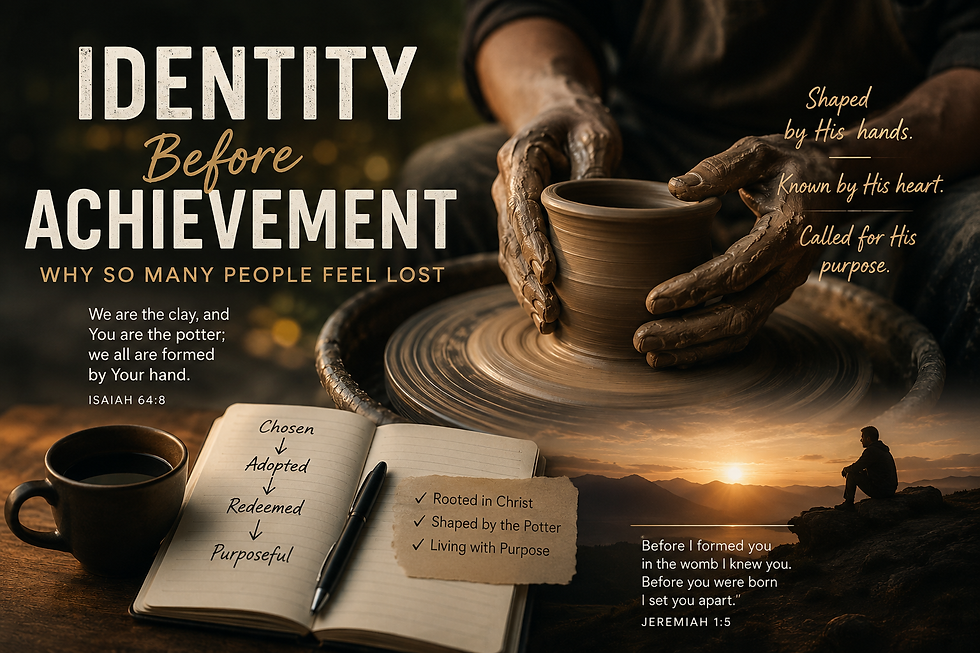
Because Christianity was never meant to be sustained by performance. It was always meant to flow from identity. Our spiritual life does not begin with activity; it begins with being.
Doing is what we do. Being is who we are.
An actor can perform a role that is not truly theirs. They can wear the costume, learn the script, and imitate the behaviour. But eventually the curtain closes and the costume comes off.
God never called His children to act like Christians. He called us to become His sons and daughters.
That is why so many believers live exhausted lives. They are trying to maintain a version of holiness externally while internally still uncertain of who they are. They know the language of faith but struggle to rest in the security of belonging.
Yet Scripture declares something far greater than religious performance:
“If anyone is in Christ, he is a new creation; the old has gone, the new has come!” — 2 Corinthians 5:17
This is not symbolic language. God is not merely improving the old version of you. He is bringing you into new birth.
Through Christ, the very life of God is placed within us. Peter writes that we are born again “through the living and enduring word of God” (1 Peter 1:23). The image of God, fractured through sin, begins to be restored through relationship with Christ.
And like every child, we are expected to grow into who we already are.
Imagine looking at a photograph of your grandfather as a baby. The tiny child in that picture and the elderly man you know are the same person. One carried the potential of the other long before maturity appeared outwardly.
The same is true spiritually.
When you are born again, you may still look immature, uncertain, wounded, or incomplete. But heaven already knows who you are becoming. God does not relate to you only according to your current stage—He relates to the identity He has birthed within you.
That is why spiritual growth is not about pretending to be someone else. It is about becoming increasingly aligned with who God says you already are.
Jesus said:
“Anyone who has seen me has seen the Father.” — John 14:9
The delight of the Father is to see His nature reflected through His children. Not copied mechanically but expressed uniquely through redeemed human lives.
Religion tries to imitate Christ externally.Identity allows Christ to be expressed internally.
That is the difference between performance and transformation.
Even the fruit of the Spirit in Galatians 5 is described as fruit, not achievement. Love, joy, peace, patience, kindness, gentleness, faithfulness, self-control—these are not spiritual trophies earned through striving. They are the natural expression of Christ growing within us.
Fruit grows because life is present.
Created with Intent
Long before you took your first breath, you existed in the heart of God.
Genesis tells us:
“So God created mankind in his own image…” — Genesis 1:27
This is not poetic exaggeration. It is the foundation of identity.
You were not randomly assembled. You were intentionally formed.
Before we can fully understand what it means to be in Christ, we must first understand what it means to be created by God. Because when people lose sight of their origin, they inevitably begin questioning their worth.
Paul writes:
“For we are God’s workmanship, created in Christ Jesus…” — Ephesians 2:10
The Greek word for “workmanship” is poiēma—the word from which we get poem. You are God’s craftsmanship. His artistry. His intentional design.
God did not mass-produce humanity like an assembly line. He handcrafted people with personality, emotion, gifting, temperament, instinct, creativity, and purpose.
Yet many of us learned identity from broken places.
We allowed pain to define us. Trauma shaped us. Fear interpreted us. Shame named us. Failure labelled us. Even success sometimes distorted us.
The voices around us became louder than the voice that created us.
But God never abandoned His original intention.
Psalm 139 reminds us:
“You created my inmost being; you knit me together in my mother’s womb… I am fearfully and wonderfully made.” — Psalm 139:13–14
Before you had breath, you had value. Before you failed, you were known. Before you doubted, you were loved.
And perhaps one of the most healing revelations a believer can receive is this:
God does not merely love you out of obligation. He delights in what He made.
I remember the moment the Holy Spirit began revealing this truth deeply to me. I realised I was not condemned to repeat cycles of addiction, brokenness, alcoholism, failure, or destructive patterns. I was not trapped forever by environment, history, family culture, or personal weakness.
I began to see the possibility of who God intended me to become.
Not merely a “West End Kid” from Kimberley. Not merely the product of limitation or struggle. But someone created with divine purpose and eternal intention.
That revelation broke chains inside me. It filled me with hope, courage, faith, and determination to become who Christ intended me to be.
That is the power of identity revelation.
When you understand that your identity begins with God’s intention rather than your history, you stop striving to manufacture worth. You begin learning how to live from it.
From Orphan to Son
One of the greatest miracles of salvation is not merely forgiveness.
It is adoption.
Romans 8 says:
“The Spirit you received brought about your adoption to sonship. And by him we cry, ‘Abba, Father.’” — Romans 8:15
God could have chosen many ways to describe His relationship with us. Creator and creation. Master and servant. King and subject.
Instead, He chose Father and child.
This changes everything.
The orphan spirit says: You are alone. Earn your place. Protect yourself. Perform well enough to be accepted.
But the Spirit of adoption says: You belong already.
Many believers intellectually know they are loved by God, yet emotionally still live like servants trying to secure approval.
That orphan mindset often reveals itself through striving, comparison, control, fear of rejection, performance spirituality, or constant anxiety about being enough.
We see the roots of this all the way back in Genesis.
After Adam and Eve sinned, their first instinct was not repentance—it was hiding. Shame convinced them that exposure meant rejection. Fear drove them away from the very presence that could heal them.
Humanity has been hiding ever since.
Yet Jesus came to end that separation.
“I will not leave you as orphans…” — John 14:18
The gospel is not merely an invitation to behave better. It is an invitation to come home.
Adoption in the Roman world was permanent. An adopted child received full legal standing, inheritance rights, and family identity. They could not simply be discarded later.
That is the picture Scripture uses for you.
You are not tolerated by God. You are treasured.
You are not a spiritual employee. You are family.
And healing begins the moment we stop trying to earn the Father’s affection and start learning how to receive it.
Becoming Who We Already Are
Spiritual maturity is not the process of becoming someone else.
It is the process of increasingly agreeing with heaven about who God says you are.
The Christian life is not about pretending to be holy while secretly remaining empty. It is about Christ being formed within us until His life becomes visible through ours.
That is why identity matters so deeply.
Because if you do not know who you are, you will spend your life trying to prove yourself.
But when identity becomes settled:
Worship becomes response instead of performance.
Prayer becomes relationship instead of transaction.
Obedience becomes love instead of fear.
Ministry becomes overflow instead of validation.
You stop living for acceptance. You begin living from belonging.
And slowly, day by day, Christ is revealed through your humanity.
Not as an actor wearing a costume. But as a son or daughter becoming fully alive in the Father’s love.
Truth to Embrace
I was created intentionally by God.
My identity is not rooted in my past, my pain, or my performance.
I am not an orphan striving for approval; I am a child who belongs.
God does not merely tolerate me—He delights in me.
Spiritual growth is becoming who Christ has already declared me to be.
Comments